Mental tools to improve performance under pressure in athletes
CONTACT US
Athletes often reduce their primary objective in high-performance environments to one outcome: winning. The constant pressure to meet personal expectations, while also responding to the demands of coaches, teammates, supporters, and organizations, can feel overwhelming, especially during periods of fatigue, injury, illness, or reduced performance.
Within such a demanding environment, personal leadership is essential. Personal leadership enables athletes to deal with the complicated demands of elite sport while maintaining ownership over their development, decision-making, and performance.
One of the important skills in personal leadership is the ability to perform under pressure (PUD). High-performance environments are unpredictable and emotionally demanding; athletes are constantly required to assess situations, adapt quickly, and make effective decisions under stress. The ability to remain calm, focused, and proactive under pressure often determines whether talent can consistently translate into performance.
To consistently PUD and recover effectively away from competition, athletes need to develop psychological tools such as breath control, attentional focus, emotional regulation, and visualization. These tools enhance PUD; they directly influence how athletes respond to stress, setbacks, uncertainty, and high-expectation environments. Developing those tools is therefore an essential part of personal leadership. Athletes who learn to regulate their cognitive and emotional responses are better equipped to remain composed under pressure, adapt to challenges, and sustain performance over time(Stamatis et al., 2020). Mental tools training should therefore be considered equally important as physical, technical, and tactical development.
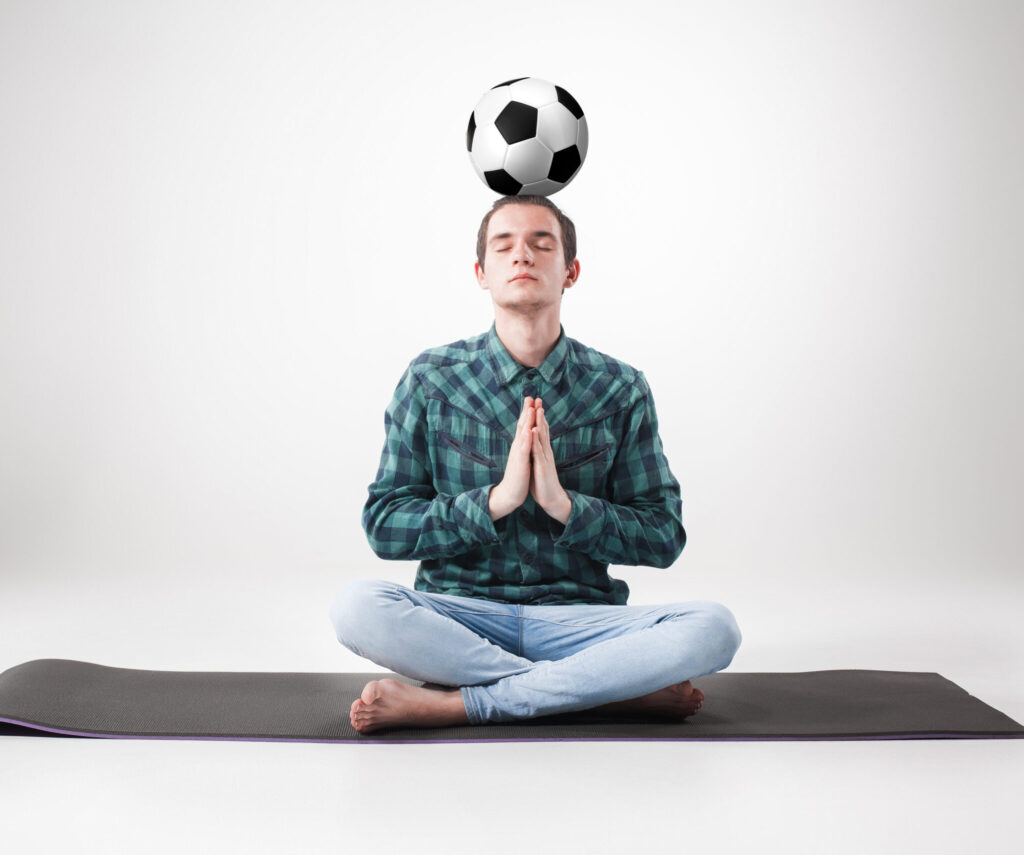
Control of breath:
Athletes need to control their breath because it can improve their physical and mental performance. Slow, deliberate breathing has been shown to be an important tool to regulate the emotional state and performance of athletes, while also being able to increase concentration and stress management under pressure (Karjalainen et al., 2025). Breathing exercises can be used before, during, and after training or games:
- Slow breathing (inhale for 5 seconds and exhale for 5 seconds) while using belly breathing for 5-10 minutes.
- Box-to-box breathing (5 seconds inhale, 5 seconds hold, 5 seconds exhale, 5 seconds hold) while incorporating belly breathing for a duration of 5-10 minutes.
These breathing protocols can effectively improve the mental state of the athlete and increase performance and recovery. This essential tool gives a strong foundation for creating an athlete that is more able to remain calm and focused, regardless of the pressure or emotions involved on and off the pitch.
Attentional focus:
During a season, game, or training, many distractions can arise that are out of the control of the athlete. These distractions can have detrimental effects on the performance of the athlete, such as missing chances to score, by example. Controlling attentional focus on the tasks of the athlete is, therefore, an important tool in PUD. Mental tools that are frequently used are routines or self-talk. To illustrate these tools:
- Routines: Athletes can create routines that allow for recognition of patterns within their training and match activities to a certain effect, which contributes to focus on their task.
- Self-talk: Focusing the athletes’ attention on themselves and on their specific goal that they need to accomplish (Hatzigeorgiadis et al., 2011).
Improving situational knowledge by following this routine, along with the use of self-talk, helps individuals achieve a calmer mental state, which facilitates better attentional focus and is essential for elite high performance (Rupprecht et al., 2021).
Emotional regulation:
Emotional regulation contains how athletes regulate their emotions in stressful situations. This is important, since emotions can appear suddenly, remain for longer periods of time, and influence well-being and performance. Emotional regulation is an internal process and differs for each athlete (Singh & Kumar, 2024). One tool to use is reflecting on situations that evoked strong emotions during training, match play, or in their private life. By recognizing the trigger, the emotions, thoughts, and behavior, and the effect it had on performance, an athlete is better prepared when the same emotions surface again. Hereby they can more easily influence the effect of their emotions on behavior. Doing these steps adequately will result in less or a shorter duration of strong emotions and improved performance or recovery in an elite high-performance environment (Singh & Kumar, 2024). Breathing exercises like the ones mentioned above are also advised to use in regulating emotions.

Visualization:
The last mental tool to mention is visualization. Visualization of common or specific situations in training or match play increases confidence and dedication of athletes. By visualizing the situation beforehand, a feeling of control is achieved, which allows for increased mental control and decreased anxiety (Thilakarathna & Joniton, 2026). Even when setbacks occur, being present and visualizing new situations in the future can improve mental recovery and improve the performance of an athlete. This technique can also be used in emotional regulations after a losing game, which is an essential catalyst in overcoming setbacks in the future.
Practical implications:
- Professionals and athletes in elite sports need to be aware that mental tools are important to PUD as part of personal leadership.
- Mental tools are trainable, and the capability to effectively utilize these tools is developed through repeated experiences both on and off the pitch.
- Training mental tools should be as important as physical, technical, and tactical development to sustain performance in an elite, high-performance environment.
References :
Hatzigeorgiadis, A., Zourbanos, N., Galanis, E., & Theodorakis, Y. (2011). Self-Talk and Sports Performance. Perspectives On Psychological Science, 6(4), 348–356. https://doi.org/10.1177/1745691611413136
Karjalainen, S., Kujala, J., & Parviainen, T. (2025). Neural activity is modulated by spontaneous and volitionally controlled breathing. Biological Psychology, 197, 109026. https://doi.org/10.1016/j.biopsycho.2025.109026
Rupprecht, A. G. O., Tran, U. S., & Gröpel, P. (2021). The effectiveness of pre-performance routines in sports: a meta-analysis. International Review Of Sport And Exercise Psychology, 17(1), 39–64. https://doi.org/10.1080/1750984x.2021.1944271
Singh, J., & Kumar, R. (2024). Emotion regulation and sports performance: A systematic review. Journal of Chemical Health Risks. https://www.jchr.org/index.php/JCHR/article/view/6355
Stamatis, A., Grandjean, P., Morgan, G., Padgett, R. N., Cowden, R., & Koutakis, P. (2020). Developing and training mental toughness in sport: a systematic review and meta-analysis of observational studies and pre-test and post-test experiments. BMJ Open Sport & Exercise Medicine, 6(1), e000747. https://doi.org/10.1136/bmjsem-2020-000747
Thilakarathna, A., & Joniton, S. (2026). The effectiveness of visualization techniques in reducing performance anxiety among athletes: A systematic review. International Journal Of Sports Health And Physical Education, 8(4), 35–40. https://doi.org/10.33545/26647559.2026.v8.i4a.373
Result is no coincidence.
It is measurable.